
Experts said onion prices, which are seeing deflation, are also headed to high-inflation territory in the coming months.
As per data released by government on Thursday, price of pulses became cheaper by 5.63 per cent year-on-year.
Inflation fell marginally to 3.01 per cent in the week ended August 27 from 3.08 per cent a week ago, despite rise in prices of food, aviation fuel and manufactured items.

Wholesale price-based inflation, which dipped to sub-zero levels following the impact of the global crisis, has started firming up and rose to 7.3 per cent in December, 2009.

Meanwhile, inflation of non-food articles was at 15.50 per cent for the week ended July 9, compared to 15.20 per cent in the previous week.
Inflation rose to 3.83 per cent for the week ended January 12, against 3.79 per cent in the previous week mainly due to rise in prices of manufactured items and some food articles. The wholesale price-based inflation stood at 6.15 per cent in the corresponding week a year ago.

Inflation declined marginally to 7.45 per cent in October even though prices of food items like rice, wheat pulses and potato showed a rising trend.
Inflation rose to 4.67 per cent for the week ended July 22, from 4.52 per cent in the previous week mainly due to increase in the prices of vegetables, pulses, industrial fuel and some manufactured items.
Inflation rose for the fifth consecutive week to 5.89 per cent during the week ended June 12, mainly due to rise in prices of fruits and vegetables, tea, eggs, minerals and manufactured products.
The UPA government's commitment to keep the price rise under check notwithstanding, inflation rose by 0.47 per cent to 4.67 per cent for the week ended May 15 due to surging prices of mass consumption items like vegetables, milk and edible oils.

'Spending by the middle class is limited with a focus on savings. However, there is buoyancy at the top-end.'
Inflation rose to 3.42 per cent for the week ended September 22, compared to 3.23 per cent in the previous week, mainly due to rise in prices of manufactured items like salt, imported edible oil and some food products. The wholesale price-based index stood at 5.43 per cent in the corresponding week a year ago.
There is little to suggest inflation levels will come down since you hardly see the same levels of seasonality in prices that were there earlier.

Data released on Thursday showed prices of essential commodities like cereals went up by 12.7 per cent, rice by 11.75 per cent, wheat 12.6 per cent and pulses rose by 42 per cent.
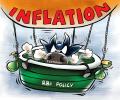
Inflation in food articles basket was 6.99 per cent In May, 2019, down from 7.37 per cent in April. However, onion prices spiked in May with inflation at 15.89 per cent, as against (-) 3.43 per cent in April.
Wholesale prices based inflation rose by 0.10 per cent to stand at 4.92 per cent during the week ended August 12, as against 4.82 per cent in the previous week due to rise in prices of essential items like fruits and vegetables.\n\n
Costlier fuels, including LPG, pushed up inflation to 5.38 per cent for the week ended December 6 -- the fourth week in a row that saw rising inflation -- even as prices of vegetables, rice and some edible oils declined.
Inflation rose to 5.91 per cent during the week ended April 23 as vegetables, fruits, edible oil, industrial fuel and manufactured products became costlier.
The rate of price rise of food items was over 15 per cent during the same week last year.

Finance Minister Pranab Mukherjee termed the rise in food inflation as an area of 'grave concern'.
The central bank is struggling to do so, after unleashing a panicky expansionary policy after the Lehman crisis.
Eggs, meat and fish also became 13.36 per cent more expensive on an annual basis, while cereal prices were up 4.13 per cent.
In line with the Centre's expectation of a benign price level, inflation fell further to 5.11 per cent in the penultimate week of 2004-05 fiscal, but was higher than 4.53 per cent a year-ago.
A sharp fall in iron ore prices could affect only a marginal decline in inflation to 5.23 per cent for the week ended March 12 since essential commodities like vegetables and fruits and several manufactured products became costlier.

Food inflation, as measured by Wholesale Price Index, stood at 9.13 per cent in the previous week.
After remaining firm for two consecutive weeks, inflation fell marginally by 0.14 per cent to 4.26 per cent for the week ended April 24 even as prices rose for fruits, vegetables, eggs and various manufactured items, including edible oils.
Food articles inflation dips to 8.14% from 9.50% last month.
This is the second week in a row when inflation remained in negative territory. The wholesale price index stood at 11.80 per cent during the corresponding week a year ago.
Inflation rose to 4.96 per cent for the week ended July 1 from 4.84 per cent
Inflation fell below the five per cent mark to stand at 4.85 per cent for the week ended May 26 from 5.06 per cent in the previous week, as the prices of essential food items like pulses and fruits and vegetables declined.
There was a marginal increase in the prices of cement, and manufactured food products such as bran (6 per cent), rice bran oil (3 per cent) and sooji (1 per cent). However, prices of groundnut oil fell by 2 per cent. Although the prices of crude oil have almost touched $100 a barrel, it did not impact the inflation rate as the government has not passed on the burden to consumers.
Slightly lower prices of food items like fruits, vegetables and milk pushed inflation down to to 12.34 per cent from 12.40 per cent a week ago.
Inflation dips to 8.40 per cent for the week ended November 22 from 8.84 per cent in the previous week.

Inflation eased marginally to 9.59 per cent in April, but cost of some vegetables and metals remained high.
Inflation, remained in negative territory for the 7th month in May
Headline inflation rose to 9.44 per cent in June on the back of rising prices of fuel and manufactured products, which may prompt the Reserve Bank to raise key rates again in its quarterly policy review later this month.

Overall inflation, as measured on the basis of the Wholesale Price Index, has been revised to 9.04 per cent for March from the original projection of 8.98 per cent.
Food inflation remained in the negative zone for the third straight week, at (-)0.42 per cent for the week ended January 7, mainly due to fall in prices of onion and vegetables.
It was almost 23 per cent during the second week of June, 2010.
 © 2026 Rediff.com - Advertise with us - Disclaimer - Privacy Policy - Sitemap - Feedback - About us - Terms of use - Grievances